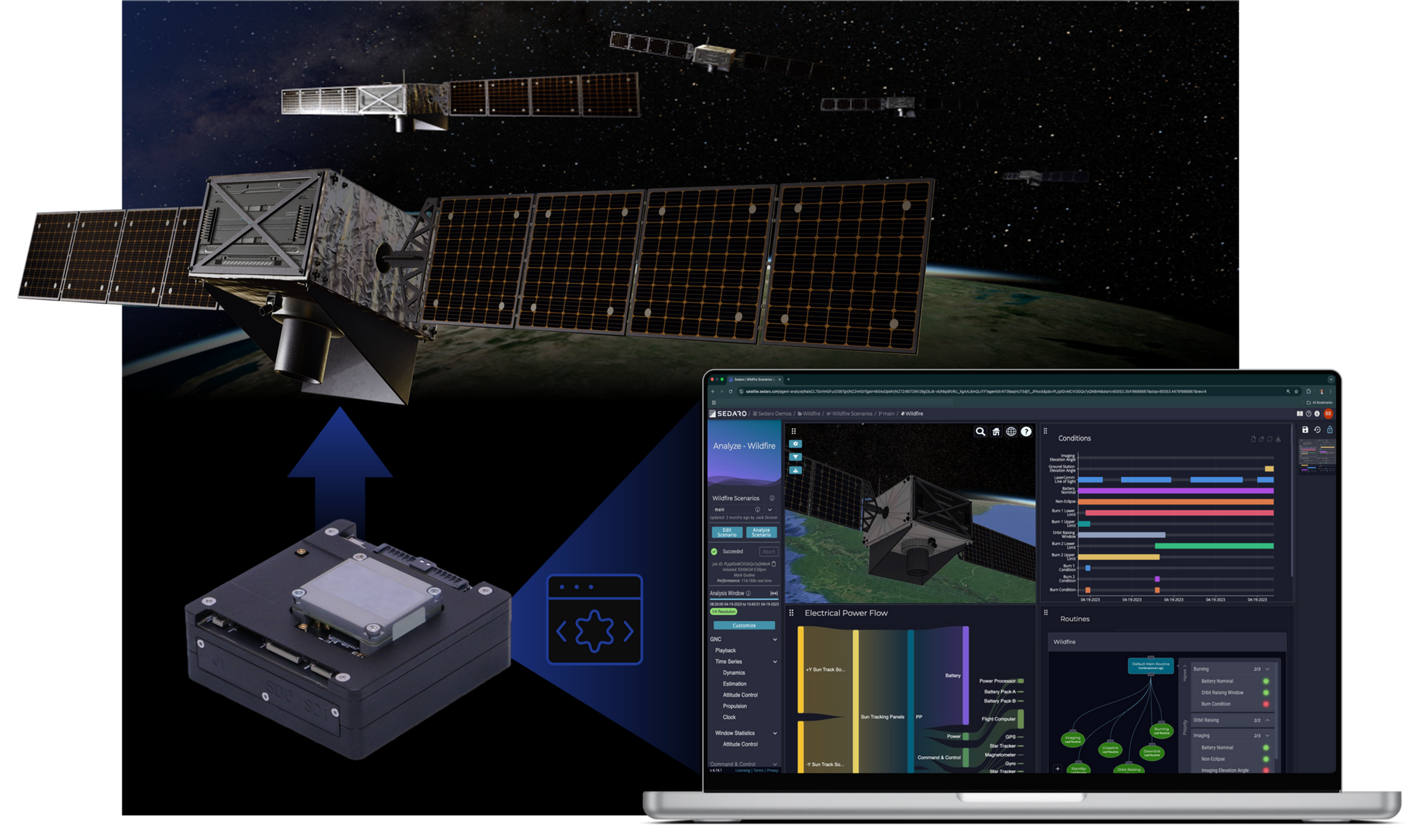
Arlington, VA · March 28, 2025 —Sedaro Corporation (Sedaro), a leading provider of advanced Aerospace & Defense simulation software, proudly announces the successful on-orbit demonstration of their self-aware satellite autonomy solution, Sedaro Autonomy Framework for the Edge (SAFE).
This autonomy solution, powered by a simulator generated in Sedaro's cloud platform, was successfully uplinked and executed onboard a NOVI Space Inc. (NOVI) satellite flying their new, 2nd generation SP240 onboard computer.
SAFE was prototyped under a Phase I SpaceWERX Small Business Innovation Research (SBIR) grant. According to the principal investigator on this effort, Sedaro CTO and Co-founder Sebastian Welsh,
“Satellite edge autonomy is essential for sustained commercial success and strategic advantage in space. Over the past decade, the proliferation of constellations in low-earth orbit has driven increasingly automated approaches to satellite mission ops from the ground. A highly congested, contested, and dynamic space operating environment demands that we take the next step and bring this automation to the edge.
Sebastian Welsh·CTO & Co-founder·Sedaro
In this successful on-orbit demonstration, NOVI's edge processor ran 150 simulations of its own host spacecraft's subsystems, using SAFE to evaluate the potential outcomes of near-term behaviors and operational decisions. This self-aware prediction of outcomes was driven by integrated, multi-physics simulation of orbital motion, the space environment, and the host vehicle's control system, flight software logic, and power subsystem dynamics. NOVI's edge processor was able to execute the Sedaro edge simulator at over 200× real time.
According to Welsh, “This on-orbit performance proves the technical viability of our solution, which directly translates the heritage, physics-based simulation approach we use for ground-based mission ops to the edge.”
NOVI's SP240 is built upon the AMD Versal Adaptive Compute Acceleration Platform (ACAP). Its modular architecture consolidates functions into one compact, power efficient form factor. NOVI's mission provides an early operational demonstration of a Versal-based edge-processor in Low Earth Orbit (LEO).
The Versal has a dual-core ARM-Cortex A72 1.3 GHz processing system with 8 GB of DDR4-3200 memory, supporting high-performance computations necessary for AI machine learning and complex system simulations. The Versal ACAP is further paired with a radiation-hardened ARM M4 MCU from Vorago featuring HARDSIL® technology to enhance reliability in a LEO radiation environment.
“NOVI's and Sedaro's successful on-orbit demo validates an approach to autonomy that can deliver value in the very near future onboard government and commercial space assets. We plan to open-source the SAFE framework to accelerate adoption and disrupt the extremely slow and expensive process of innovation that is the norm in space and defense.
Robbie Robertson·CEO·Sedaro
“It was great to work with the Sedaro team to rapidly integrate new capabilities — moving from concept to execution in just a matter of weeks, underscoring our vision for agile, AI-powered space infrastructure that accelerates innovation and unlocks real-time intelligence for commercial and government missions alike.
Dr. Michael Bartholomeusz·CEO·NOVI
This research was, in part, funded by the U.S. Government. The views and conclusions contained in this document are those of the authors and should not be interpreted as representing the official policies, either expressed or implied, of the U.S. Government. Public Affairs approval # AFRL-2025-1627.
About Sedaro
Sedaro is a leading provider of advanced Aerospace & Defense simulation software located in Arlington, VA. Sedaro's sole focus is the development and implementation of the Sedaro Platform, a cloud-scalable enterprise software for collaborative modeling, predictive simulation, digital integration, and advanced analytics. Alongside the Sedaro Platform, Sedaro implements their platform for customers and maintains related open-source technologies.
About NOVI
NOVI is a Space AI infrastructure and compute company. In addition to providing the space industry with TRL 9, flight-proven OBCs, NOVI is developing and deploying a constellation of multi-sensor edge-processing satellites for EO, coupled to a full-stack data, algorithm, and intelligence management platform named VISTAsat™. This is an innovative space AI marketplace that provides open-access to our growing satellite network, and enables commercial companies, governments and developers to harness real-time space-based sensors, processors and intelligence, further changing the cost paradigm to drive innovation, create new use-cases and redefine how industries leverage EO.
About SpaceWERX
As the innovation arm of the U.S. Space Force and a unique division within AFWERX, SpaceWERX inspires and empowers collaboration with innovators to accelerate capabilities and shape our future in space. Headquartered in Los Angeles, SpaceWERX employs 40 military, civilian and contractor personnel executing an annual $457 million budget. Additionally, SpaceWERX partners with Space Systems Command's Commercial Space Office (COMSO) as a collaborative program. Since it was aligned under AFRL in Aug. 2021, SpaceWERX has executed 1,106 contracts worth more than $897 million to strengthen the U.S. defense industrial base and drive faster technology transition to operational capability. For more information, visit: spacewerx.us.
About Air Force Research Laboratory (AFRL)
The Air Force Research Laboratory is the primary scientific research and development center for the Department of the Air Force. AFRL plays an integral role in leading the discovery, development, and integration of affordable warfighting technologies for our air, space and cyberspace force. With a workforce of more than 12,500 across nine technology areas and 40 other operations across the globe, AFRL provides a diverse portfolio of science and technology ranging from fundamental to advanced research and technology development. For more information, visit afresearchlab.com.